
PTFE tubing: 5 checks before purchasing PTFE Hose
The PTFE Hose: Overview of Properties, Temperature Range, and Application Limits.
A PTFE hose is an industrial hose made of polytetrafluoroethylene. It withstands continuous temperatures up to 260 °C. It is resistant to almost all chemicals. And it is physiologically harmless. This combination is offered by no other hose material.
In common parlance, it is often called a Teflon hose. Teflon is a brand name. PTFE is the material. Both terms mean the same material.
This guide answers the most important questions before making a selection: temperature range, suitable media, risks, sizes, and designs. And what you should look out for regarding the origin.
The 5 points before buying, the overview
Anyone wanting to buy a PTFE hose checks five things beforehand. Every point determines operational safety:
- Temperature: Does the entire hose assembly withstand the operating temperature, not just the material? The braid and fitting set the limit. To the Temperature section
- Medium: Is PTFE suitable for the medium, and does it require a conductive or gas-tight design? To the Media section
- Risks: Are static charge, cold flow, and permeation considered in the design? To the Risks section
- Design and pressure rating: Smooth hose, corrugated hose, or braided design, matching the bending radius and operating pressure? To the Sizes and Designs section
- Raw material and documentation: Virgin PTFE with data sheet, FDA declaration, and traceability, or anonymous imported goods? To the Origin section
The short version: Anyone who can substantiate all five points with a data sheet is making a safe purchase. The details for each point follow now.

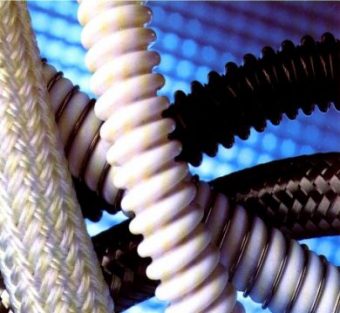
What temperature can a PTFE hose withstand?
The short answer: The material PTFE permanently withstands around 260 °C. Assembled PTFE hose lines are typically designed for −70 °C to +200 °C and can be steam-sterilized up to 260 °C.
This distinction is important. Material and hose assembly are not the same thing.
PTFE as a material is heat-resistant like almost no other plastic. The continuous use temperature is around 260 °C. This is not a theoretical value. Even after 20,000 operating hours at this temperature, the material retains half of its mechanical properties.
The upper limits are clearly defined:
- From about 300 °C, a minimal weight loss of 0.0003% per hour begins.
- At 360 °C, this value increases to 0.003% per hour.
- Above 400 °C, a faster decomposition sets in.
In practice, however, the complete hose assembly limits the application. The braid, fitting, and seal also count. The PTFE hose assemblies from Westwood are specified for −70 °C to +200 °C. For sterilization, they can be steam-sterilized in an open system up to 260 °C.
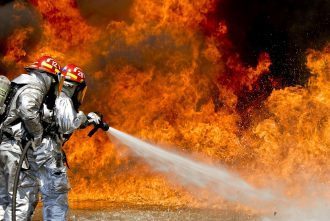
The pressure reinforcement determines the upper limit here:
- Stainless steel braid (1.4301): up to +200 °C, steam-sterilizable up to 260 °C
- PVDF braid: up to +150 °C
- PP braid: up to +90 °C
For the design, this means: First, clarify the medium and the operating temperature. Then, choose the appropriate structure. The data sheet of the specific hose assembly is always authoritative, not the material value from the table.
When is a PTFE hose the better choice than other materials?
The rule of thumb: As soon as aggressive media, high temperatures, or purity requirements come together, there is no way around PTFE.
The direct comparison shows the differences:
| Material | Continuous temperature approx. | Chemical resistance | Typical weakness |
|---|---|---|---|
| PVC | up to 60 °C | limited | embrittles, swells with solvents |
| Rubber (EPDM, NBR) | up to 120 to 150 °C | media-dependent | not oil- and solvent-resistant (EPDM) or not acid-resistant (NBR) |
| Silicone | up to 200 °C | good with aqueous media | not resistant to oils, fuels, many solvents |
| PTFE | up to 260 °C | almost universal | cold flow under continuous pressure, price |
PTFE is the right choice if at least one of these points applies:
- The medium attacks rubber or plastic hoses. Concentrated acids. Alkalis. Solvents.
- The operating temperature is continuously above 150 °C.
- The medium must not be contaminated. Pharma. Food. Analytics.
- The hose must be tasteless and odorless.
- Adhesions must be cleanable without leaving residues. The anti-adhesive surface of PTFE makes exactly this possible.
A rubber hose is cheaper. A PVC hose too. But both are wear parts as soon as the conditions get tougher. A PTFE hose practically does not age. It does not embrittle. UV radiation and moisture leave it unimpressed. Calculated over its lifespan, it is often the more economical solution.
What risks exist with PTFE hoses?
PTFE is safe in its intended use. Designers and operators must nevertheless be aware of four risks.
1. Thermal decomposition upon overheating
Above 400 °C, PTFE decomposes and releases harmful pyrolysis products. A PTFE hose must therefore never be operated beyond its temperature limit. Not even when welding or cutting in the workshop.
2. Electrostatic charging
PTFE is an excellent insulator. Exactly this becomes a risk when non-conductive media flow through the hose at high speed. Electrostatic charges are generated. With flammable media, there is a risk of ignition sparks. The solution: an electrically conductive or antistatic PTFE hose with a dissipative inner layer. For fuels, solvents, and powder transport, this design is mandatory.
3. Cold flow under continuous load
PTFE tends to creep under constant pressure. Screw connections can settle over time. High-quality hose assemblies compensate for this with professionally mounted fittings and pressure carrier braids, such as those made of stainless steel.
4. Permeation with gases
Gases can diffuse through thin PTFE walls. For gaseous media under pressure, there are therefore specially treated, gas-tight designs with reduced permeability. This is a matter for consultation, not the catalog.
All four risks are manageable. The prerequisite is the correct design for the specific application. Exactly here is where anonymous imported goods separate from a manufacturer offering technical advice.
Which media can be conveyed through PTFE hoses?
Almost all. PTFE is resistant to practically all chemicals and solvents.
These include:
- Acids, including concentrated sulfuric acid, hydrochloric acid, and nitric acid
- Alkalis, such as sodium hydroxide and potassium hydroxide, even when hot
- Solvents, including acetone, toluene, alcohols, and chlorinated hydrocarbons
- Oils and fuels, because PTFE hoses are oil-resistant and fuel-resistant
- Steam and hot water, up to the temperature limit
- Gases, in a specially treated, gas-tight design even under pressure
- Food and pharmaceuticals, because virgin PTFE is FDA-compliant, tasteless, and odorless
- Adhesives, paints, resins, because the anti-adhesive surface prevents caking
The exceptions are rare and exotic: chlorine trifluoride, oxygen difluoride, and molten alkali metals. PTFE has only limited resistance to gaseous chlorine and fluorine. In everyday industrial life, these media hardly play a role.
This universal resistance is the reason why PTFE hose assemblies are standard in the chemical, pharmaceutical, and food industries. One material. One stock item. Almost every medium.
Which sizes and designs are available?
PTFE hoses are available from capillary hoses to large nominal diameters. The Westwood product range extends from DN 1 to DN 150. The most frequently requested small nominal diameters, i.e., 2, 3, 4, 6, and 8 mm, are part of the standard range. Smooth hoses can be supplied in lengths up to 250 meters.
More important than the diameter is the design. It determines flexibility, pressure rating, and area of application:
PTFE smooth hose
Smooth, homogeneous inner and outer wall. Ideal for dosing tasks, analytics, and pneumatics. Designed without a braid for low pressure; the burst pressure is between 4 and 30 bar, depending on the nominal diameter.
PTFE corrugated hose
Spirally corrugated wall for maximum flexibility. The corrugated PTFE hose is the first choice when movement, vibration, or tight bending radii are required. With a stainless steel braid, operating pressures up to 16 bar with a fourfold safety factor are approved; higher pressures upon consultation.
Star-shaped PTFE hose
Star profile in cross-section. Combines high flexibility with improved residual emptying. Interesting for applications with cleaning requirements.
Film-wrapped hose
Constructed from wrapped and sintered PTFE films. For demanding geometries and large nominal diameters.
Stainless steel braided PTFE hose
PTFE core with stainless steel braid (material 1.4301) as a pressure carrier. The metal-sheathed structure drastically increases the pressure rating: Braided smooth hoses achieve operating pressures of over 300 bar with small nominal diameters. Alternatively, there are braids made of PP (lighter, up to 90 °C) and PVDF (chemically resistant from the outside, up to 150 °C).
Electrically conductive PTFE hose
Antistatic design with a black conductive core or integrated conductive strips. The leakage resistance is below 106 ohms. Mandatory wherever flowing media create a risk of ignition.
Gas-tight design
Specially treated core with reduced permeability for gaseous media under pressure. A special version of the braided smooth hose.
PTFE heat shrink tubing
Shrinks onto the component under heat. For coating and insulating tasks, for instance on rollers or sensors.
Added to this are connection fittings in all common variants. From DN 10 upwards, a flared connection is possible: The hose is pulled through the nozzle and folded over at the sealing face. The medium then only touches PTFE, never the fitting. For particularly aggressive media and sterile applications, this is the crucial difference.
Selecting the right combination of design, wall thickness, pressure carrier, and fitting is a matter of configuration. A reputable manufacturer supplies the data sheet with pressure ratings, bending radii, and temperature limits for this purpose. Without a data sheet, there is no operational safety.
How is PTFE manufactured?
PTFE is produced by the polymerization of tetrafluoroethylene. The result is a white powder or a dispersion, the raw material for all PTFE products.
The special feature: PTFE cannot be melted and injection-molded like other plastics. The melt viscosity is too high for that. Hoses are therefore produced in a multi-stage process:
- Paste extrusion. PTFE powder is processed into a paste with a lubricant and extruded through a die under high pressure.
- Drying. The lubricant is expelled.
- Sintering. At around 360 to 380 °C, the particles fuse into a homogeneous, pore-free hose.
- Shaping. Corrugated hoses and star profiles receive their geometry in a subsequent forming step.
The raw material is decisive for the quality. There are two classes here:
- Virgin PTFE is new material. It offers full chemical resistance, FDA compliance, and maximum purity. The standard for chemistry, pharmaceuticals, medical technology, and food contact.
- Regenerated PTFE contains reprocessed material. It is cheaper and a sensible option for uncritical mechanical components. For hose assemblies in contact with media, it is the wrong choice.
German or Chinese production, what matters?
The price difference between imported goods and German production is real. The quality difference too. It is evident in five criteria that every buyer can check:
1. Proof of raw material
Does the hose demonstrably consist of virgin PTFE? With imported goods, the proportion of regenerate can often not be proven. With media contact, this is an exclusionary criterion.
2. Conformity and documentation
REACH compliance, FDA declaration for food contact, data sheet with pressure ratings and temperature limits. A German manufacturer supplies these documents as standard. If they are missing, the operator bears the risk.
3. Traceability
From which batch does the hose come? In the event of a damage claim and during an audit, this question is decisive. Anonymous merchandise can rarely answer it.
4. Tolerances and assembly
Wall thickness, roundness, fitting assembly. A hose assembly is only as safe as its weakest crimp. Production and assembly from a single source avoid interface errors.
5. Consultation and delivery time
Which design for which medium? Which pressure rating at which temperature? No webshop answers these questions. Added to this is the practical advantage of short delivery routes: Custom-made products from Germany are often available faster than standard goods from overseas.
A word on the environmental balance of production
In the manufacture of fluoropolymers, perfluorooctanoic acid (PFOA) was previously used as an emulsifier. The substance is extremely long-lasting and accumulates in the environment. Since July 4, 2020, PFOA has been banned via the EU POP Regulation; this applies to manufacturing, use, and import. According to the Bavarian State Office for Health and Food Safety, environmental pollution is caused in particular by emissions during the manufacturing process.
That is exactly why the production location counts. Where chemical and environmental laws are strictly controlled, the supply chain is also cleaner. With imported goods, buyers should actively request the PFOA certificate, because the limit value of 0.025 ppm also applies to imported products.
For non-critical applications, imported goods may suffice. As soon as aggressive media, high pressures, food, or pharmaceutical contact are involved, documented quality from the manufacturer is not an optional extra. It is operational safety.
Conclusion: The right PTFE hose is a matter of configuration
PTFE is the most versatile hose material in the industry. Temperature-resistant up to 260 °C. Resistant to almost all media. Food-safe, aging-resistant, easy to clean.
The risks, namely static charge, cold flow, and permeation, are known and can be solved constructively. Provided that design, wall thickness, and fitting suit the application.
Westwood GmbH has been designing PTFE hose assemblies since 1996 and manufacturing them in Germany, from smooth hoses to corrugated hoses and stainless steel-sheathed special solutions. To our PTFE hoses from the manufacturer
FAQ: Frequently asked questions about PTFE hoses
What is the difference between a Teflon hose and a PTFE hose?
None in the material. Teflon is a brand name for PTFE. A Teflon hose and a PTFE hose consist of the same material: polytetrafluoroethylene.
Is a PTFE hose food-safe?
Yes, if it consists of virgin PTFE. The material is FDA-compliant, tasteless and odorless, and does not release any substances into the medium. The manufacturer’s declaration of conformity proves this.
Is a PTFE hose oil-resistant?
Yes. PTFE is resistant to oils, greases, and fuels. For flammable media, an electrically dissipative design should be used.
Is a PTFE hose gas-tight?
Generally yes, but gases can permeate through thin walls. For gaseous media under pressure, there are specially treated, gas-tight designs with reduced permeability. The data sheet provides information.
Which PTFE hose is suitable for tight bending radii?
The corrugated PTFE hose. Its corrugated wall allows significantly tighter bending radii than a smooth hose, without the risk of kinking and without cross-sectional narrowing.
Where can I find the data sheet for a PTFE hose?
From the manufacturer. Reputable providers make data sheets with pressure ratings, temperature limits, and bending radii available; at Westwood, for example, the PTFE hose catalog as a PDF download.